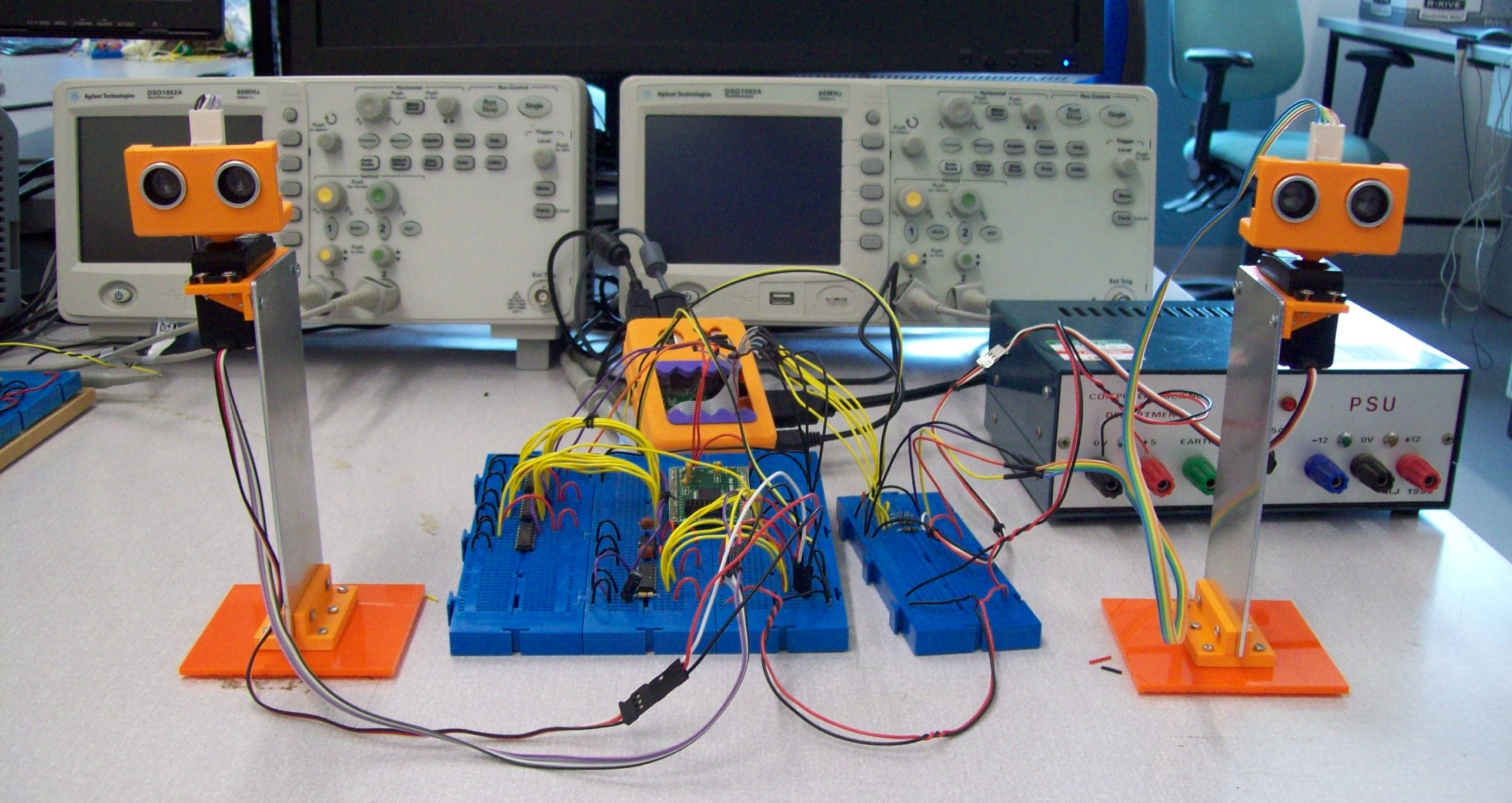
Radar systems have a number of defense as well as civil applications. Air traffic control uses radars to track aircraft's on the ground and in the air, and to guide planes for smooth landings. Law enforcement officers use radars to detect the speed of passing vehicles. Geologists use these radars to map the Earth and other planets. Military uses these for surveillance. Meteorologists use radars to track storms, hurricanes and tornadoes. The list is really just endless. A radar system consists of a transmitter that transmits a beam towards the target, which is then reflected by the target as an echo signal. The reflected signal is received by a receiver. This receiver processes the received signal and provides such information as the presence of a target, distance, position (either moving or is stationary) or speed, which is displayed on a display unit. Actual radar systems are built with high-power transmitters and receivers, huge antennae, complex processing systems using digital signal processors and large displays. The way they work is that the ultrasonic waves to detect an object and measure its distance and angular position, and displays the same on a 20×4 or similar size LCD screen. It can detect multiple objects at different angles and distances as new objects are detected. This means that the distance and angle of all objects are displayed one by one on the same LCD screen.

Above is a list of possible parts which would be used to put together an ultrasonic radar. Even things like ARDUINO uno are capable of putting together an ultrasonic radar. With only really acquiring 7 parts, there are not that hard to get a hold of as long as you know what you're doing.

No comments:
Post a Comment