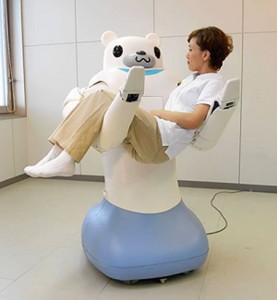
Robot for Interactive Body Assistance
By:Jacqueline Ray
A common problem in the nursing field is how to lift or move a patient. For many nurses, it is extremely hard to lift patients, whether it is out of bed and into a wheel chair or back into bed. This issue has caused injury for many of the nurses, and it may even put the patient at risk. The Robot for Interactive Body Assistance (RIBA) strives to put an end to this problem. RIBA's design mimics the structure of human arms, which allows it lift the patients. It has the capability to lift a patient from bed or off of the floor if they have fallen. While this device would be extremely useful in a hospital setting, it may not be cost-effective or a priority in many medical institutions.

In conclusion, RIBA is an up and coming tool in the medical field, but it is not ready for use in hospitals quite yet. While the expected market cost for RIBA is unclear, it is certain that having RIBA available for immediate use throughout the hospital would not be cost effective. Furthermore, it would be best to wait until RIBA, or an alternative product, could handle a weight of 300 lbs. or greater, which would allow it to lift heavier patients. RIBA shows a lot of potential, but it will be a while before it will be a practical for use throughout hospitals.

No comments:
Post a Comment