Damage to the nation's failing infrastructure could be minimized and mitigated by "mood ring materials."

Fiberglass and aluminum test strips illuminated in UV light. The white areas show the polymer/quantum dot coating.
When President-elect Donald Trump takes office, he has promised to establish a $1 trillion infrastructure improvement program. As estimated by the The American Society of Civil Engineers, more than $3.6 trillion in investment is needed by 2020 to rehabilitate and modernize the nation's failing infrastructure. The "mood ring materials" come in for the development of new and improved methods for detecting damage in these structures before it becomes critical.
Cole Brubaker, a doctoral student in civil engineering who is part of an interdisciplinary research team at Vanderbilt University's Laboratory for Systems Integrity and Reliability (LASIR) developing the new sensing system explains, sprinkle a pixie dust of nanoparticles into a batch of clear polymer resin and you get "a smart material that changes color when it is damaged or about to fail, what I call a 'mood ring material.'"
 |
| Like a mood ring that changes color according to one's mood, scientists are seeking materials that will change color when they are about to fail in order to improve the safety of infrastructure. |
One of the hot new fields in civil, mechanical and aerospace engineering is smart sensing technology. These efforts have generally focused on developing networks of physical sensors that are attached to structures of interest. The problem with this approach is that it has been hindered by high cost as well as power and data processing requirements. To monitor the structures in an efficient and cost-effective fashion, the LASIR researchers are taking a different tack by incorporating fluorescent nanoparticles into the material itself that react to stress by changing their optical properties in order to create a new kind of detection system.
 |
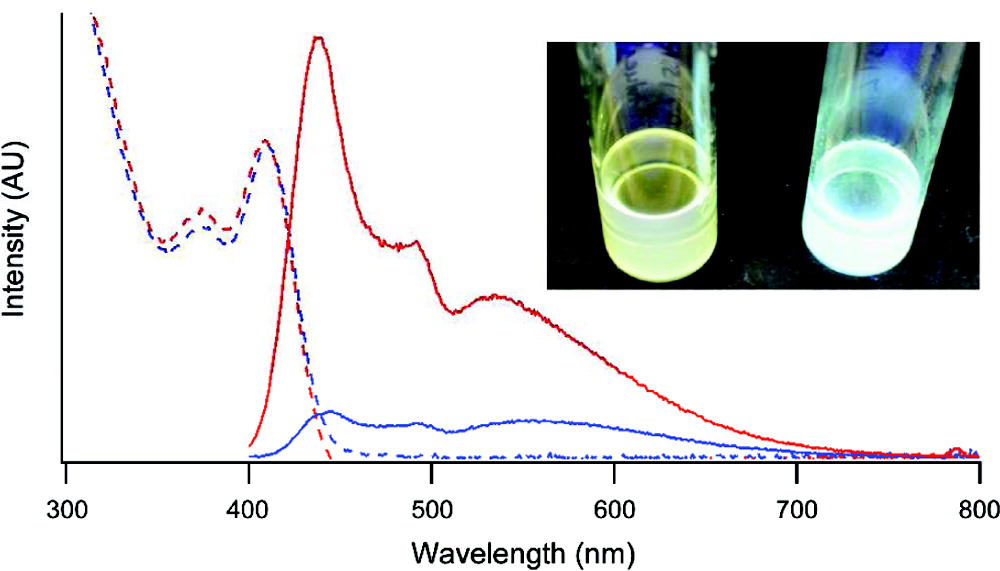
| Fluorescent Nanoparticles LASIR Director, Douglas Adams, Daniel F. Flowers Professor of the civil and environmental engineering say that, "Currently, there are two ways to keep everything from bridges to aircraft safe, one is to send people out to look at them with a flashlight. The problem with this is that it is labor-intensive and the people can't see very small cracks when they form. The other is to install elaborate sensor networks that constantly look for small cracks and detect them before they grow too large. The problem is that these networks are very expensive and, in the case of aircraft, add a lot of weight. So we need to somehow change the materials we are using so they illuminate these tiny cracks." Published last April in the Proceedings of the SPIE Conference on Sensors and Smart Structures Technologies for Civil, Mechanical and Aerospace Systems, the team's initial studies have determined that adding a tiny concentration of special nanoparticles (1 to 5 percent by weight) to an optically clear polymer matrix produces a distinctive light signature that changes as the material is subjected to a broad range of compressive and tensile loads. Many research teams are using nanoparticles to create smart materials, but the Vanderbilt group has a special advantage. They are using a particular type of nanoparticle called a white light quantum dot. These white light quantum dots are unique because they emit white light where other quantum dots only emit light at specific wavelengths. |
 |
| White Light Quantum Dots
These special quantum dots were accidentally discovered in 2005 in the laboratory of Sandra Rosenthal, Jack and Pamela Egan Professor of Chemistry at Vanderbilt. "We were trying to make the smallest cadmium selenide quantum dots possible and, when we did, we were astonished to discover that they emit in a broad spectrum," she recalled."White light quantum dots have very unique optical properties compared with other nanoparticles," said Talitha Frecker, a chemistry graduate student who is participating in the study. "The white light fluorescence is a surface phenomenon."
A video demonstrating how white light quantum dots work under different light wavelengths.
The researchers theorize that the quantum dots emit light in a broad spectrum because more than 80 percent of the atoms lie on the surface. They also know that the bonds between the surface atoms and molecules surrounding them plays a critical role. Brubaker says, "The end result is that the strength of the quantum dot emissions gives us a permanent record of the level of stress that a material has experienced."In this fashion, the researchers have verified that the material can act as a new kind of strain gauge that permanently records the cumulative amount of stress that the material to which it is applied experiences.
"There is a lot we have to learn before we can create a smart material that is ready for real world applications, but all the signs are positive," said Adams. "Some of our commercial partners are very interested so there is a good chance that it will be adopted if it performs as well as we think it will."
|

No comments:
Post a Comment